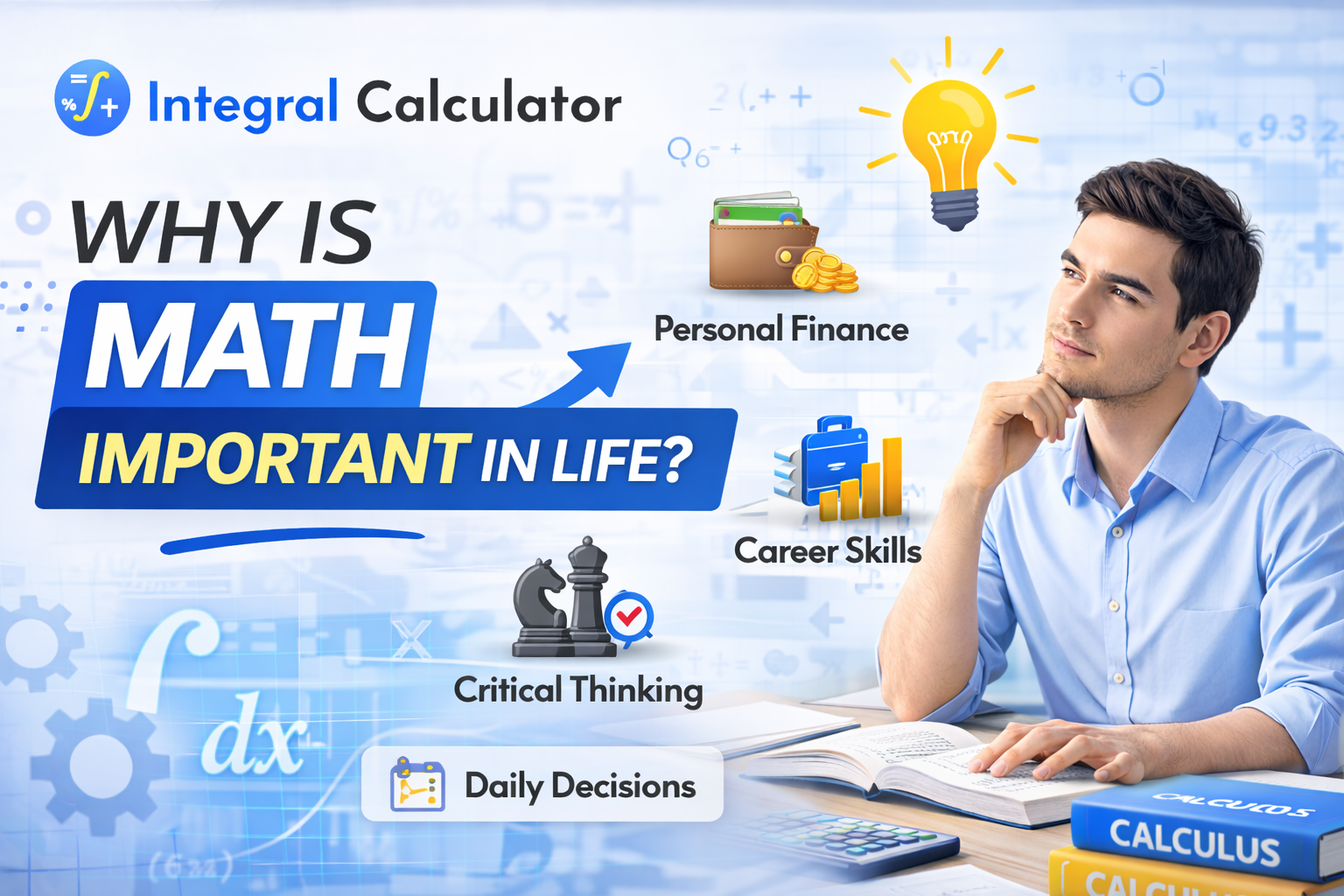
You rely on math more than you realize, whether you are budgeting for groceries, comparing mortgage rates, or planning a cross-country trip. When you ask why is math important in life, you are really asking how numbers shape your decisions, opportunities, and future stability.
This article shows you exactly how math strengthens your thinking, finances, career prospects, and everyday confidence, so you can see its value far beyond the classroom.
Math Shapes Your Everyday Decision-Making
Every day, you make dozens of choices that depend on logical evaluation and numerical reasoning. When you compare prices, calculate tips, or decide between two job offers, you rely on mental math and structured thinking. Math trains you to break complex situations into smaller parts so your decision-making becomes more accurate and less emotional.
You constantly measure trade-offs such as cost versus benefit or time versus convenience. By practicing math regularly, you sharpen your ability to analyze risks and rewards before committing to a choice. This habit protects you from impulsive spending, unrealistic expectations, and poorly planned commitments.
When you understand patterns and relationships between numbers, you see consequences before they unfold. That awareness empowers you to choose wisely in both personal and professional settings. Over time, strong math skills turn careful thinking into a lifelong advantage.
Financial Literacy Starts With Strong Math Skills
Money management depends on your ability to calculate interest rates, percentages, and long-term growth. When you track expenses, plan savings goals, or evaluate credit card offers, math gives you clarity instead of confusion. Without numerical understanding, financial decisions become guesswork.
According to the U.S. Bureau of Labor Statistics, consumer spending continues to rise annually, making budgeting skills more important than ever. If you cannot calculate compound interest or compare loan terms, you risk paying thousands more than necessary. Math helps you identify hidden costs and choose options that align with your long-term goals.
When you build financial literacy, you gain confidence in managing investments, retirement accounts, and tax obligations. That confidence reduces stress and increases your ability to plan ahead. Ultimately, math allows you to control your money instead of letting money control you.
Math Strengthens Critical Thinking and Problem-Solving
When you solve a math problem, you identify known information, define the unknown, and apply a logical method. That structured approach transfers directly into real-life problem-solving situations. Whether you are resolving workplace conflicts or planning a home renovation, the same analytical process applies.
Mathematics encourages you to test assumptions before accepting conclusions. You learn to verify results rather than rely on vague impressions. This mindset protects you from misinformation and poor judgment in a world flooded with data.
As you practice solving equations or analyzing patterns, your brain becomes more efficient at recognizing relationships. Research has shown that consistent math engagement supports cognitive flexibility and attention control. Over time, you develop sharper reasoning skills that benefit every area of life.
Math Is the Backbone of Technology and Innovation
Modern technology would not exist without advanced mathematical principles. From smartphone encryption to GPS navigation systems, algorithms rely on complex calculations. When you understand even basic concepts behind these systems, you appreciate how math drives innovation.
Fields such as artificial intelligence, cybersecurity, and data science depend heavily on calculus and statistics. If you have ever wondered how continuous change is measured in physics or economics, reviewing how integrals operate clarifies that process, which is explained clearly in how do integrals work. That foundation shows you how mathematical modeling predicts trends and guides technological development.
As technology expands across industries, mathematical literacy becomes increasingly valuable. Employers seek professionals who can interpret data and translate numbers into actionable insights. When you strengthen your math skills, you position yourself at the center of modern progress.
Math Enhances Career Opportunities
Nearly every profession uses math in some capacity, even if it is not obvious. Healthcare professionals calculate dosages, construction managers measure materials, and entrepreneurs analyze profit margins. When you master math, you expand your career possibilities rather than limit them.
The U.S. Bureau of Labor Statistics projects strong growth in math-intensive careers such as data science and actuarial analysis. These roles offer competitive salaries because they require precise analytical thinking. By strengthening your numerical abilities, you make yourself more adaptable in a changing job market.
Employers value employees who can interpret reports, identify trends, and support strategic planning. When you demonstrate mathematical confidence, you signal reliability and competence. That reputation increases your chances of advancement and leadership opportunities.
Math Improves Time Management and Planning
Time is one of your most valuable resources, and managing it requires quantitative thinking. When you estimate travel time, calculate project deadlines, or divide tasks into manageable segments, you use mathematical reasoning. Effective time management begins with understanding how long activities truly take.
You often convert minutes into hours or compare durations when planning schedules. These simple calculations help you avoid overcommitment and missed deadlines. By accurately estimating workload, you reduce stress and increase productivity.
Planning for the future also involves forecasting outcomes based on available data. When you analyze past performance and project future results, you apply mathematical patterns. That ability ensures your plans remain realistic and achievable.
Math Builds Confidence Through Measurable Progress
Progress in math is visible and measurable, which strengthens your sense of achievement. When you solve increasingly complex problems, you see direct evidence of improvement. This measurable growth builds confidence that extends beyond mathematics.
As you overcome challenging equations, you develop perseverance and resilience. You learn that consistent practice leads to mastery, even when problems initially seem difficult. That mindset carries into other areas of life where persistence matters.
Confidence grows when you can independently verify your answers. Rather than relying on guesswork, you trust your reasoning and conclusions. Over time, this assurance shapes how you approach new challenges and unfamiliar situations.
Math Connects You to Nature and the Physical World
Patterns in nature often reflect mathematical structures. From the symmetry of snowflakes to the geometry of honeycombs, mathematical principles appear everywhere. When you recognize these patterns, you gain a deeper appreciation for the world around you.
Geometry explains architectural design and structural stability. Engineers rely on precise measurements to ensure bridges and buildings remain safe. Without mathematical accuracy, modern infrastructure would collapse under pressure.
Even natural growth patterns follow predictable sequences. Understanding these sequences helps scientists model ecosystems and climate systems. When you grasp these relationships, you see how math reveals hidden order in everyday life.
Math Strengthens Data Literacy in a Digital Age
You encounter statistics daily in news headlines, social media posts, and marketing claims. If you cannot interpret percentages, averages, or probabilities, you risk misunderstanding important information. Math equips you to evaluate data critically rather than accept it blindly.
For example, understanding growth rates allows you to distinguish between short-term spikes and long-term trends. When analyzing areas under curves in economics or physics, insights discussed in what are integrals used for demonstrate how accumulation and change are measured precisely. This perspective helps you interpret complex reports with confidence.
Data literacy protects you from manipulation and exaggeration. When you calculate values yourself, you reduce reliance on misleading summaries. That independence strengthens your analytical autonomy.
Math Encourages Structured Thinking in Complex Situations
Complex problems require systematic approaches rather than random guesses. Mathematics trains you to define variables, set constraints, and apply consistent methods. This structured thinking prevents chaos when situations become overwhelming.
In advanced topics, distinguishing between types of integrals clarifies how results change depending on context, as explained in indefinite vs definite integrals. Recognizing such distinctions improves your ability to interpret nuanced differences in professional environments. That precision reduces costly misunderstandings.
When you approach life methodically, you make fewer errors and achieve clearer outcomes. Structured reasoning fosters reliability and efficiency. Over time, that consistency becomes one of your strongest assets.
Practical Tools Reinforce Mathematical Understanding
Practicing math consistently improves retention and speed. When tackling advanced calculus or verifying solutions, using an Advanced Integral Calculator allows you to confirm results while focusing on conceptual understanding. Tools like this support learning without replacing critical thinking.
Technology can enhance your mathematical growth when used responsibly. Instead of avoiding complex topics, you gain confidence by checking your reasoning step by step. That process deepens comprehension and reduces fear of difficult problems.
By combining independent practice with reliable tools, you build accuracy and fluency. This balanced approach strengthens both your technical skills and your analytical independence.
Conclusion
When you ask why is math important in life, you uncover its influence on every major decision you make. Math shapes your financial stability, career growth, time management, and critical thinking skills, while also connecting you to technology and the natural world. As you strengthen your mathematical foundation, you gain confidence, clarity, and control over your choices, allowing you to navigate life with precision and purpose.

Jason Hastings
Jason Hastings is a seasoned technical content writer with a strong foundation in software engineering and IT infrastructure. He specializes in creating in-depth tutorials, whitepapers, and product documentation on topics such as cloud computing, DevOps pipelines, and enterprise software integration. Known for his clear, precise writing style and commitment to accuracy, Jason helps developers and CTOs alike navigate complex technical challenges and adopt best practices.